
In daily dealings we address one another as ‘brother’.
We are bound together. That is more than being comfortable in each other’s company. Out of this mutual bond we build a community in which respect and peace stand central.
This community life takes shape through activities held in common.
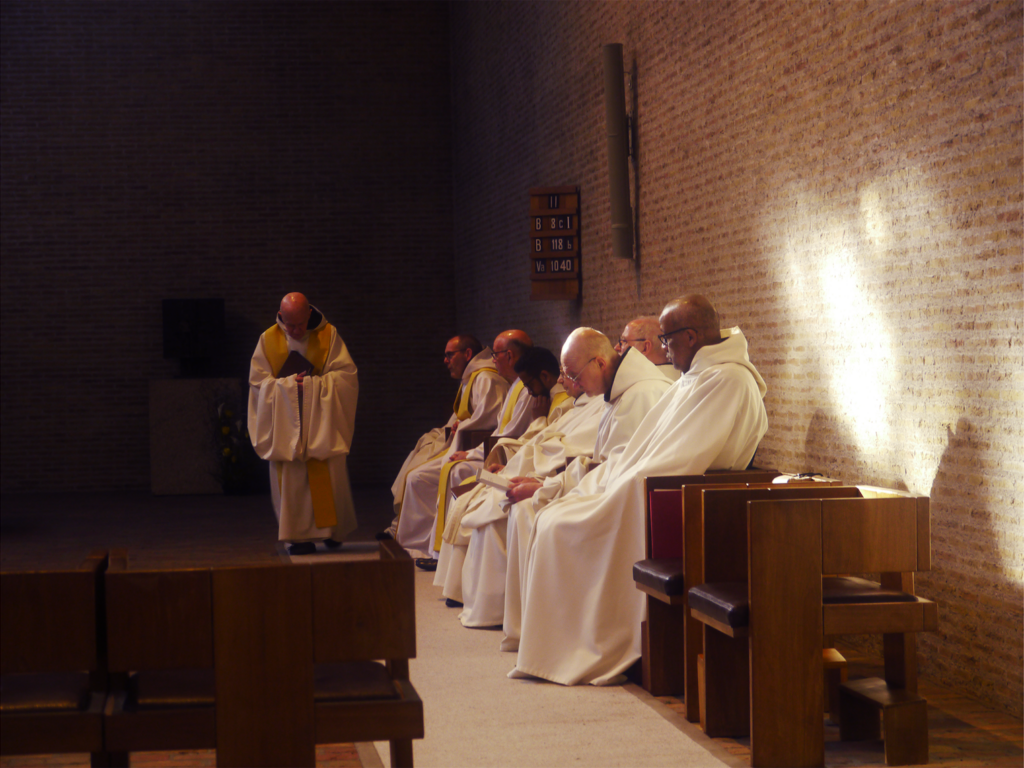
Our community life shows itself in praying together, taking our meals together, pondering the Scriptures and receiving the teachings of Father Abbot.
Our white cowl, or monastic habit, is an expression of our shared dedication to God. As Trappists we are members of a worldwide Cistercian order.
Living by a rule
Seen from outside, such a monastery – certainly among Trappists – seems strict and rigid. But if that were the hallmark of monastic existence, our life would remain narrow and meagre.
Take that Rule of Benedict for monks.
Written well over 1500 years ago.
Admittedly: something strict comes across, and at times something dated too.
Why, then, do we actually follow that rule, a whole life long?
We do so because, like everyone, we long for life. Real life.
The prologue of the Rule of St Benedict puts it thus: “See how the Lord in his goodness shows us the way of life.”
And where does that life lead?
Again according to that same Rule: “Above all, do not be daunted and do not flee the way of salvation, which is always narrow at the outset. As one makes progress in the monastic life and in faith, the heart is enlarged and one runs on with an inexpressible and joyful love.”
Praying every day asks for discipline. Once you grasp that through this praying you learn to become still, room opens in your heart to listen to God’s word of love. An inexpressible and joyful love. Meister Eckhart: “We do not pray. We are prayed”.
And all that praying – does it not become dull?
Seen from outside, such a monastic life seems strict and rigid.
But if this were the essence of monastic existence, it would remain meagre. It is about something else. The heart of the monk must ripen into a sweet and gentle fruit.
Living as a Trappist monk – can that be summed up in words?
Hard to do, because every person has his own story.
It is a simple and sober existence. A quiet life that we share as brothers, in which, like everyone, we must learn to let go in order to become free.
Our deepest identity does not depend on what makes us particular.
Br Manu: “When we lose sight of this, we risk getting stuck on the exotic side of our monastic life, on what is peculiar, different from the rest.
For there is a danger that we come to confuse the particular with the essential.
Because what is most essential the Cistercians share with all Christians. I would even go a step further: Cistercian life is only meaningful if it is life to the full, if it is a way of becoming human.”
Click here for a summary of the life of Benedict, man of God
Becoming a monk
The guesthouse is the ideal place to become more deeply acquainted with monastic life.
People come here on retreat, individually or in a group.
They come, they go, and they come back.

And sometimes it happens. Someone is touched,
feels called to this life.
To come to a clearer understanding of this there is the possibility of a conversation with a brother.
A possible candidate may visit the guesthouse a number of times. Afterwards he may be offered the chance of a stay within the community.
After entering, the candidate lives for a year as a postulant in the monastery.
There follows the novitiate, lasting two years, in which he is further initiated into monastic life.
After that the novice may bind himself to the community for three years.
After a stay of about 6 years the candidate binds himself to God and to the community by monastic profession – for life.
You can contact us by letter, telephone or e-mail.
Br novice master
Saint Sixtus Abbey
8640 Westvleteren
+ 32 (0)57 40 03 76