
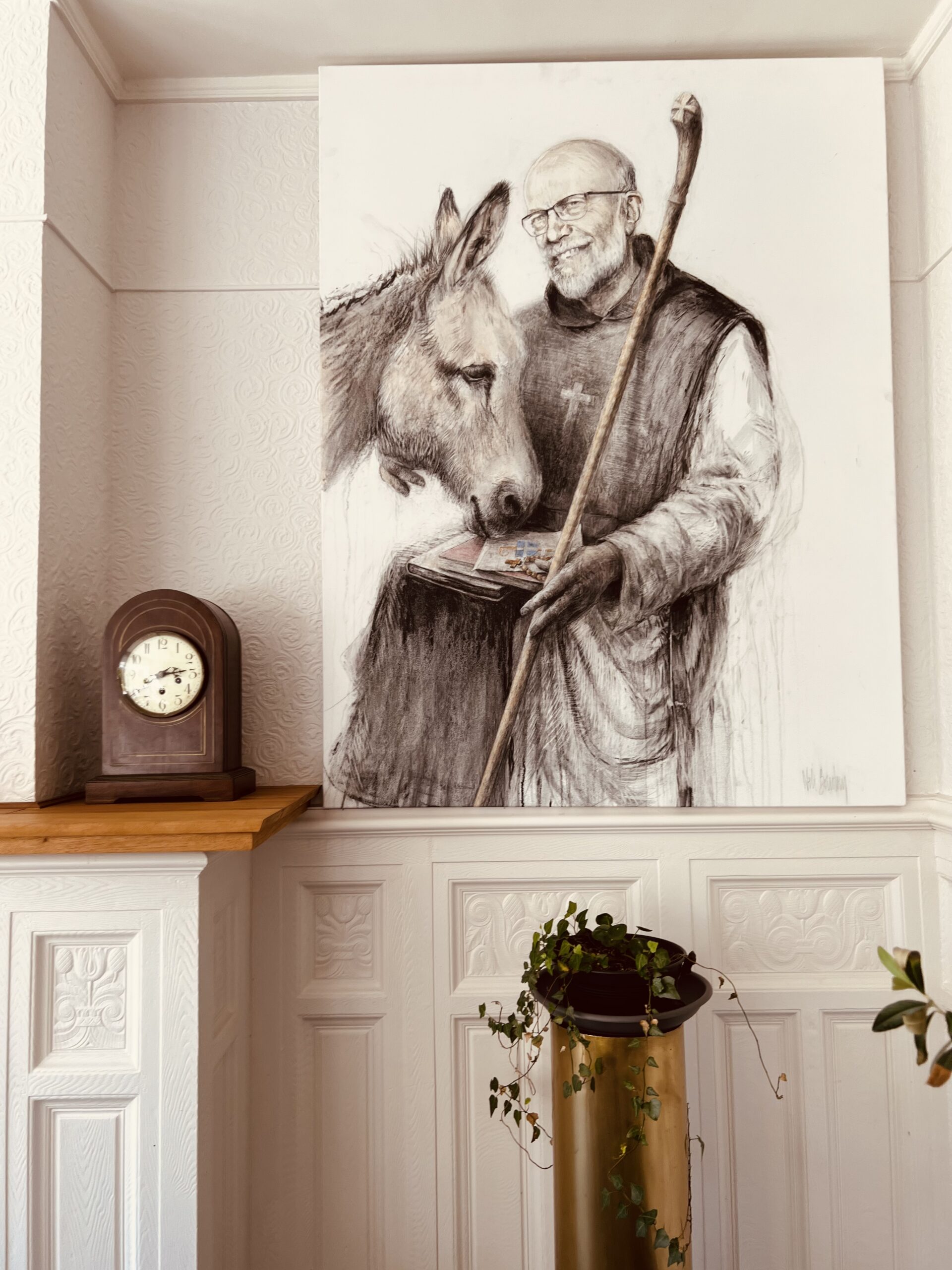
Below, frequently asked questions together with the answers
Why has Br Manu offered his resignation as abbot?
On 11 September 2026 Br Manu turned 75. In principle Trappist abbots are elected for an indefinite term (formerly this was strictly for life). An abbot is asked to offer his resignation at the age of 75.
What exactly is an abbot?
An abbot is the superior of an abbey community. He does not, however, stand above the community, but in the midst of it. In the tradition of Benedict and of the Cistercian order he is first of all a spiritual father to the brothers. The abbot carries responsibility for the whole of the abbey community: prayer, community life, formation, work and administration.
Is an abbot comparable to a CEO?
Not really. Of course an abbot also carries final responsibility for the running of the abbey and for the activities that enable the community to provide for its livelihood. But his task is essentially different from that of a company director. He is first and foremost the spiritual head of a community that lives according to the Rule of Benedict.
Three years ago Alain Monteyne was appointed general director. His role stands outside the spiritual hierarchy (he is not a monk and has no say in the monastic life). The general director takes care of the business interests and the patrimony of the Abbey, as well as the day-to-day management of the brewery. This is important for the Abbey’s continuity in the long term.
Who can become abbot?
According to the constitutions of the Order of Cistercians of the Strict Observance, any brother who has made solemn profession in the Trappist order and who is at least 35 years of age may be elected abbot.
Who elects the new abbot?
The new abbot is elected by the conventual chapter, which consists of the voting members of the abbey community. It is therefore a choice made by the monks of Saint Sixtus Abbey themselves.
Is the new abbot elected for a fixed term?
In principle the constitutions of the Order of Cistercians of the Strict Observance provide that an abbot is elected for an indefinite term.
How does such an election proceed?
It takes place in an atmosphere of prayer and discretion. The ballot is secret.
Are there lists of candidates?
No, an abbatial election is not an election in the classic political sense. No campaign is conducted. In prayer and shared responsibility the monks seek the brother who can best serve the community.
When must the election take place?
The election takes place at the earliest fifteen days after the office falls vacant and at the latest within three months, unless there is a valid impediment.
What majority is required?
To be elected, an absolute majority of the valid votes is required. Invalid votes and abstentions are not counted. If that majority is not reached at once, voting continues until a candidate obtains the required majority.
Who is Br Manu?
Manu Van Hecke was born on 11 September 1951 in Sint-Laureins. After studying philosophy at the KU Leuven he entered Saint Sixtus Abbey of Westvleteren in 1981. In 1990 he was ordained priest. On 9 November 1996 he was elected abbot. He has been abbot of Saint Sixtus Abbey for almost thirty years. That makes him one of the longest-serving abbots in the recent history of the Belgian Trappist abbeys.
What characterises his abbacy?
Br Manu has led the abbey for three decades. That is a considerable time and makes his abbacy an important period in the history of Saint Sixtus.
His abbacy was marked by continuity, simplicity and fidelity to the monastic character of Westvleteren. Even in periods of great international interest in the beer, the abbey held to its own rhythm and to the principle that the brewery is simply an economic activity by which the brothers can provide for the needs of the abbey community, as foreseen in the Rule of Benedict. The income arising from the sale of beer is also used to make the necessary investments. A substantial part of the profit is devoted to solidarity within the Order, to development projects and to other good causes.
What important developments took place during his abbacy?
During his abbacy part of the abbey was thoroughly rebuilt and renewed. In 2007-2011 the new enclosure, among other things, was built. In addition, considerable investment was made in the quality and sustainability of the brewery, without fundamentally altering production capacity. A new bottling plant was brought into service, the lagering cellar and the fermentation room were modernised, a new building for secondary fermentation was erected and a water treatment installation was laid out. Investment was also made in generating renewable energy by means of solar panels.
In 2023 the abbey community decided – for the first time in the history of Saint Sixtus Abbey – to appoint a general director to take care of the business interests and the patrimony of the Abbey, as well as the day-to-day management of the brewery. In this way the Abbey’s continuity can be assured in the long term.
How many monks live at Saint Sixtus Abbey?
At this moment there are 17 monks.